Learn how to make classic French macarons with smooth almond flour shells, delicate ruffled feet, chewy centers, and creamy vanilla buttercream.
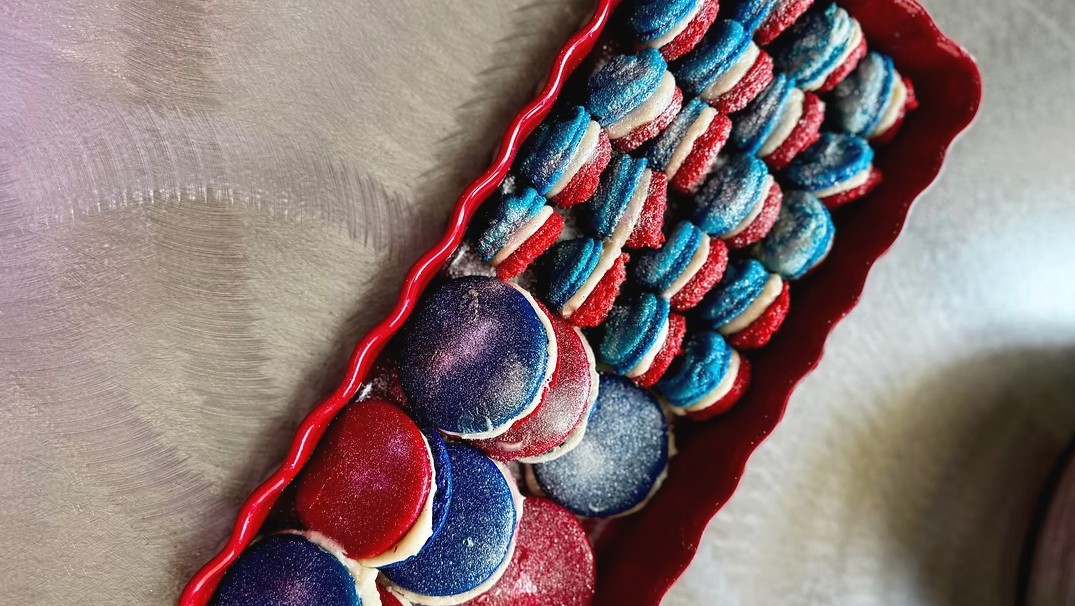
Elegant and delicately sweet, this Classic French Macarons Recipe with Vanilla Buttercream Filling features smooth almond flour shells, lightly crisp exteriors, chewy centers, and signature ruffled feet. A creamy vanilla buttercream brings the sandwich cookies together with a rich flavor that complements the almond shells.
French macarons have a reputation for being challenging, but careful preparation makes the process much more approachable. Finely processing and sifting the dry ingredients helps create smooth shells, while properly whipped egg whites provide structure. Folding the batter to the correct consistency allows the macarons to settle into even rounds without spreading excessively.
Allowing the piped shells to rest before baking is another essential step. During this resting period, a dry skin forms on the surface, encouraging the shells to rise upward and develop their characteristic feet. After assembly, refrigerating the macarons gives the filling time to soften their interiors while the exteriors retain a delicate crispness.
These colorful French macarons are beautiful additions to birthdays, bridal showers, baby showers, afternoon teas, holiday dessert platters, and other special occasions. Once you master the classic shells, you can customize them with different colors and fillings, including fruit preserves, chocolate ganache, caramel, curd, and flavored buttercream.
Directions
Step 1: Prepare the Dry Ingredients
Place the almond flour and confectioners’ sugar in a food processor. Pulse the mixture 5 to 10 times, or until it is extremely fine and thoroughly combined.
Sift the mixture through a fine-mesh sieve into a medium bowl. Discard any large almond pieces remaining in the sieve. Set the dry ingredients aside while preparing the meringue.
Step 2: Make the Meringue
Place the room-temperature egg whites in a clean, dry mixing bowl. Using an electric mixer, beat the egg whites on medium speed for approximately 2 minutes, or until they become foamy and frothy.
Slowly add the granulated sugar while continuing to mix. Increase the mixer speed to medium-high and continue beating for approximately 5 to 6 minutes, or until stiff, glossy peaks form. The meringue should hold its shape firmly when the beaters are lifted.
Add the vanilla extract and salt. Mix briefly on low speed until incorporated.
Add the gel food coloring or natural food-coloring powder and mix just until the color is evenly distributed throughout the meringue.
Step 3: Fold the Macaron Batter
Add approximately one-third of the almond flour mixture to the meringue.
Using a silicone spatula, gently fold the ingredients together by scraping around the sides of the bowl and cutting through the center.
Add the remaining dry ingredients in two more additions, folding gently after each addition. Continue folding until the batter becomes smooth and glossy.
When the spatula is lifted, the batter should slowly flow back into the bowl in thick ribbons. The ribbons should disappear into the batter after several seconds. Avoid undermixing, which can cause uneven shells, and do not overmix, which can cause the macarons to spread and become flat.
Step 4: Pipe the Macaron Shells
Line a baking sheet with parchment paper or a silicone macaron mat. Transfer the batter to a piping bag fitted with a large round tip.
Hold the piping bag approximately 1/2 inch above the lined baking sheet. Pipe circles approximately 1 1/2 inches in diameter, spacing them about 2 inches apart.
Firmly tap the filled baking sheet against the counter 5 to 10 times to release trapped air bubbles and help the batter settle into smooth circles. Use a toothpick to pop any visible air bubbles remaining on the surfaces.
Step 5: Rest the Macaron Shells
Allow the piped macarons to rest uncovered at room temperature for 45 to 60 minutes. During this time, a thin skin will form over each shell, helping the macarons rise upward and develop their signature ruffled feet during baking.
The shells are ready to bake when their surfaces feel dry and no batter transfers to a fingertip when lightly touched.
Step 6: Bake the Macaron Shells
Preheat the oven to 300°F. For the most consistent results, bake one tray at a time on the center oven rack.
Bake the macaron shells for 15 to 17 minutes. As they bake, they should develop their characteristic feet around the bases.
Gently touch the top of one shell to test for doneness. It should remain stable without wobbling. Allow the shells to cool completely before carefully removing them from the parchment paper or silicone mat.
Step 7: Prepare the Vanilla Buttercream
Place the softened butter in a large mixing bowl. Beat it with an electric mixer until smooth, creamy, and pale in color.
Gradually add the confectioners’ sugar, mixing thoroughly after each addition.
Add 2 tablespoons of heavy whipping cream, the vanilla extract, and salt.
Continue mixing until the buttercream is light, fluffy, and completely smooth. If necessary, add the remaining tablespoon of heavy whipping cream to create a soft, pipeable consistency. Transfer the finished buttercream to a piping bag.
Step 8: Assemble the Macarons
Match the cooled macaron shells into pairs of similar size. Pipe a swirl of vanilla buttercream onto the flat side of one shell from each pair.
Place the matching shell on top and press gently to create a sandwich cookie. Continue until all the macarons are assembled.
Step 9: Mature and Serve the Macarons
Arrange the assembled macarons in a single layer in an airtight container.
Refrigerate them for 24 to 72 hours before serving for the best texture.
During this maturation period, moisture from the filling gradually softens the interiors of the shells while the exteriors retain a delicate crispness. Allow the refrigerated macarons to sit at room temperature briefly before serving.
Notes
For the most accurate and consistent results, weigh the ingredients with a kitchen scale.
Room-temperature egg whites help create a strong, stable meringue.
Make sure the mixing bowl and beaters are completely clean, dry, and free from grease before whipping the egg whites.
Use gel food coloring or natural food-coloring powder. Liquid food coloring may add too much moisture to the batter.
Avoid making macarons on extremely humid days when possible because excess moisture can interfere with skin formation.
If the shells crack, they may not have rested long enough before baking.
If the macarons spread excessively, the batter was likely overmixed.
Hollow shells may indicate that the oven temperature was too high or the meringue was overwhipped.
If the shells stick to the parchment paper, they may require additional baking time. Always allow them to cool completely before removing them.
Uneven feet may indicate uneven oven heating. Carefully rotate the tray during baking if necessary.
If the shells are too crisp, allow the assembled macarons to mature in the refrigerator. Moisture from the filling will gradually soften their centers.
For jam-filled macarons, replace the vanilla buttercream with seedless raspberry jam, strawberry preserves, or apricot preserves.
To make hazelnut honey buttercream, combine 1/2 cup prepared vanilla buttercream with 1/3 cup finely ground hazelnuts and 2 tablespoons honey.
Other filling options include chocolate ganache, Swiss meringue buttercream, coffee buttercream, lemon curd, strawberry buttercream, salted caramel buttercream, pistachio buttercream, dulce de leche, chocolate-hazelnut spread, peanut butter, or thick salted caramel sauce.
Macarons are naturally made without wheat flour, but individual ingredients may be exposed to gluten during processing. When preparing macarons for someone with celiac disease or gluten sensitivity, check all packaged ingredients for appropriate gluten-free labeling and prevent cross-contact by using clean equipment, utensils, and preparation surfaces.
Store assembled macarons in an airtight container in the refrigerator for up to 5 days.
Filled macarons can be frozen in an airtight container for up to 2 months.
Thaw them overnight in the refrigerator before serving.
The total time does not include the optional 24-to-72-hour maturation period.