Make an elegant gluten-free rose cake with silky violet frosting and your choice of a custom flour blend or convenient Measure for Measure cake batter.
Delicate floral flavors, a tender crumb, and silky buttercream make this Elegant Gluten-Free Rose Cake with Violet Frosting Recipe a beautiful dessert for birthdays, bridal showers, Mother’s Day, afternoon tea, and spring celebrations. Fragrant rose cake layers are paired with creamy violet frosting for a sophisticated dessert inspired by a blooming garden.
This recipe includes two separate cake batter options. Choose one option before beginning. Option 1 uses a custom blend of gluten-free flours, while Option 2 uses gluten-free Measure for Measure flour for a simpler preparation. Do not combine the ingredients from the two cake batter options.
Option 1 produces soft, moist layers using sweet rice flour, white rice flour, tapioca flour, brown rice flour, sour cream, and milk. Option 2 requires fewer ingredients and offers a convenient alternative for bakers who prefer a prepared gluten-free flour blend.
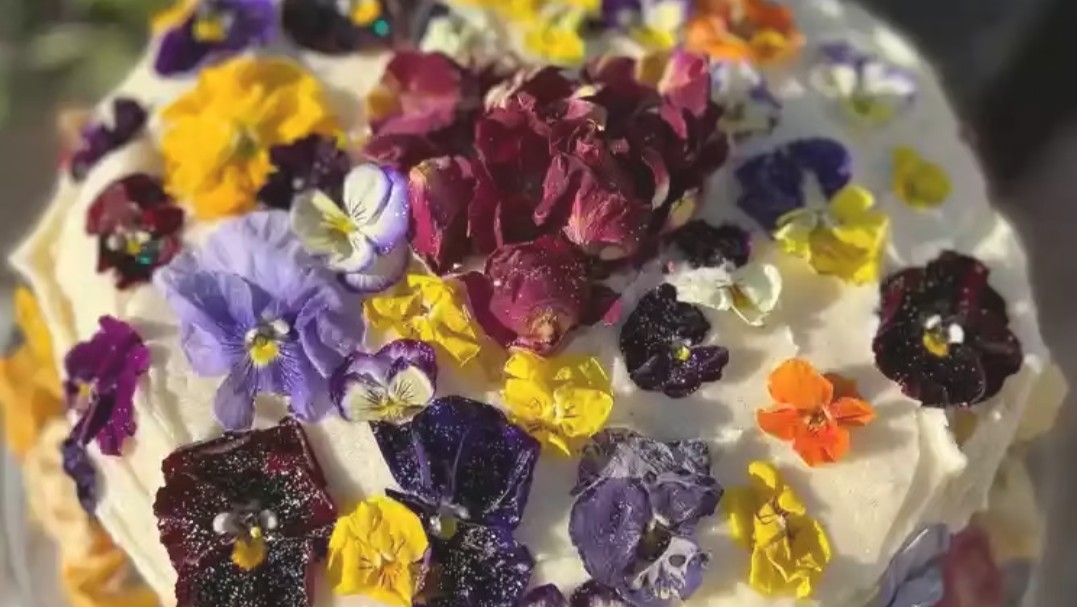
Both rose cake options pair beautifully with the same rich violet frosting. Because rose extract and violet oil vary in strength, add floral flavorings carefully. Finish the cake with edible rose petals, candied violets, or other food-safe flowers for an elegant garden-inspired presentation.
Directions
Step 1: Choose One Cake Batter Option
Before beginning, select Option 1 or Option 2. Follow only the directions for your chosen cake batter. Do not combine ingredients or directions from the two formulas.
Step 2: Prepare the Oven and Cake Pans
Preheat the oven to 350°F. Grease two 8-inch round cake pans with nonstick baking spray. Line the bottoms of the pans with parchment paper.
Option 1 Directions: Custom Flour Blend
Follow Steps 3 through 8 if you selected Option 1. If you selected Option 2, skip to Step 9.
Step 3: Combine the Gluten-Free Flours
In a medium bowl, whisk together the sweet rice flour, white rice flour, tapioca flour, brown rice flour, xanthan gum, baking powder, baking soda, and kosher salt. Whisk thoroughly so the flours, starch, binder, and leavening ingredients are evenly distributed.
Step 4: Cream the Butter and Sugar
Place the softened butter and granulated sugar in a large mixing bowl. Beat until light and fluffy.
If using neutral oil instead of butter, whisk the oil and sugar together until thoroughly combined. The oil mixture will not become as fluffy as the butter mixture.
Step 5: Add the Eggs and Extracts
Add the eggs one at a time, mixing well after each addition. Scrape down the sides and bottom of the bowl as needed.
Add the vanilla extract and rose extract. Mix until evenly incorporated.
Step 6: Add the Dry and Wet Ingredients
Add half of the dry ingredients to the egg mixture and mix just until combined.
Add the milk and sour cream. Mix gently until incorporated. Add the remaining dry ingredients and mix just until a smooth batter forms. Avoid overmixing.
Step 7: Divide and Bake the Batter
Divide the batter evenly between the prepared cake pans. Smooth the tops with a spatula.
Bake for 20 to 25 minutes, or until a toothpick inserted into the center of each cake comes out clean.
Step 8: Cool the Cake Layers
Allow the cakes to cool in their pans for 10 minutes. Carefully turn them out onto a wire rack and remove the parchment paper. Let the layers cool completely before frosting.
Skip to Step 15 to prepare the violet frosting.
Option 2 Directions: Measure for Measure Flour
Follow Steps 9 through 14 if you selected Option 2. Do not add any ingredients from Option 1.
Step 9: Cream the Butter and Sugar
Place the softened butter and granulated sugar in a large mixing bowl. Beat until the mixture is pale, light, and fluffy. Scrape down the sides and bottom of the bowl as needed.
Step 10: Add the Eggs
Add the eggs one at a time, beating well after each addition. Mixing the eggs gradually helps create a smooth, even batter.
Step 11: Add the Milk and Rose Extract
Pour in the milk and rose extract. Mix on low speed until combined. The mixture may appear slightly separated at this stage.
Step 12: Add the Gluten-Free Flour
Gradually add the gluten-free Measure for Measure flour. Mix just until a smooth batter forms, stopping to scrape the sides and bottom of the bowl as needed. Do not overmix.
Step 13: Divide and Bake the Batter
Divide the batter evenly between the prepared cake pans. Smooth the tops with a spatula.
Bake for 20 to 25 minutes, or until the centers spring back when lightly touched.
Step 14: Cool the Cake Layers
Allow the cakes to cool in their pans for 10 minutes. Carefully transfer the layers to a wire rack and let them cool completely before frosting.
Violet Frosting and Assembly
Use the following frosting and assembly directions with either cake batter option.
Step 15: Beat the Butter
Place the softened butter in the bowl of a stand mixer fitted with the paddle attachment. Beat on medium speed until creamy and smooth.
Step 16: Add the Confectioners’ Sugar
Gradually add the confectioners’ sugar in three additions, mixing on low speed after each addition. Scrape down the sides and bottom of the bowl as needed.
Step 17: Add the Floral Flavoring
Add the vanilla extract and violet oil. Mix until the flavoring is evenly incorporated.
Violet oil is highly concentrated. Taste the frosting before adding any additional oil.
Step 18: Adjust the Frosting Consistency
Add 3 tablespoons of heavy cream and beat until smooth. If the frosting is too thick, add the remaining cream a little at a time until it reaches a smooth, spreadable consistency.
Increase the mixer speed to medium and beat for 2 to 3 minutes, or until the frosting is light and fluffy.
Step 19: Fill the Cake
Place one completely cooled cake layer on a serving plate or cake stand.
Spread approximately 1/2 cup of violet frosting evenly over the top. Place the second cake layer over the frosting.
Step 20: Apply the Crumb Coat
Spread a thin layer of frosting over the top and sides of the cake to trap loose crumbs. Refrigerate the cake for 15 minutes to set the crumb coat.
Step 21: Frost and Decorate the Cake
Cover the chilled cake with the remaining violet frosting. Smooth the top and sides with an offset spatula.
Decorate with edible rose petals, candied violets, or other food-safe flowers, if desired.
Step 22: Serve the Cake
For clean slices, cut the cake with a sharp knife and wipe the blade between cuts. Serve the cake at room temperature for the softest texture and fullest floral flavor.
Notes
You must choose one cake batter option. Prepare either the custom flour blend batter or the Measure for Measure flour batter. Do not combine ingredients from the two formulas.
Option 1 requires the individual gluten-free flours, xanthan gum, leavening ingredients, sour cream, and milk listed in that section.
Option 2 uses gluten-free Measure for Measure flour and does not require the additional flours, xanthan gum, baking powder, baking soda, sour cream, or vanilla listed in Option 1.
Rose extract varies in strength by brand. If you prefer a subtle rose flavor, begin with a smaller amount and adjust carefully.
Violet oil is highly concentrated. Use only violet oil intended for culinary use, add it cautiously, and follow the manufacturer’s usage guidance.
Bring the eggs, milk, sour cream, and butter required for your selected option to room temperature before mixing. Room-temperature ingredients combine more evenly and help create a tender cake.
Avoid overmixing after adding the gluten-free flour. Excessive mixing can produce heavier cake layers.
Let both cake layers cool completely before assembling the cake. Frosting warm cake layers can cause the buttercream to soften or melt.
Use only edible flowers grown and handled for culinary use. Do not decorate food with flowers from florists, nurseries, roadsides, or plants treated with pesticides not approved for edible crops.
Store the finished cake covered in the refrigerator for up to 5 days. Allow it to sit at room temperature for approximately 30 minutes before serving for the best flavor and texture.
When preparing the cake for someone with celiac disease or gluten sensitivity, verify that all packaged ingredients, including the flour, extracts, confectioners’ sugar, baking powder, baking spray, and decorations, are appropriately labeled gluten-free. Prevent cross-contact by using clean pans, equipment, utensils, and preparation surfaces.