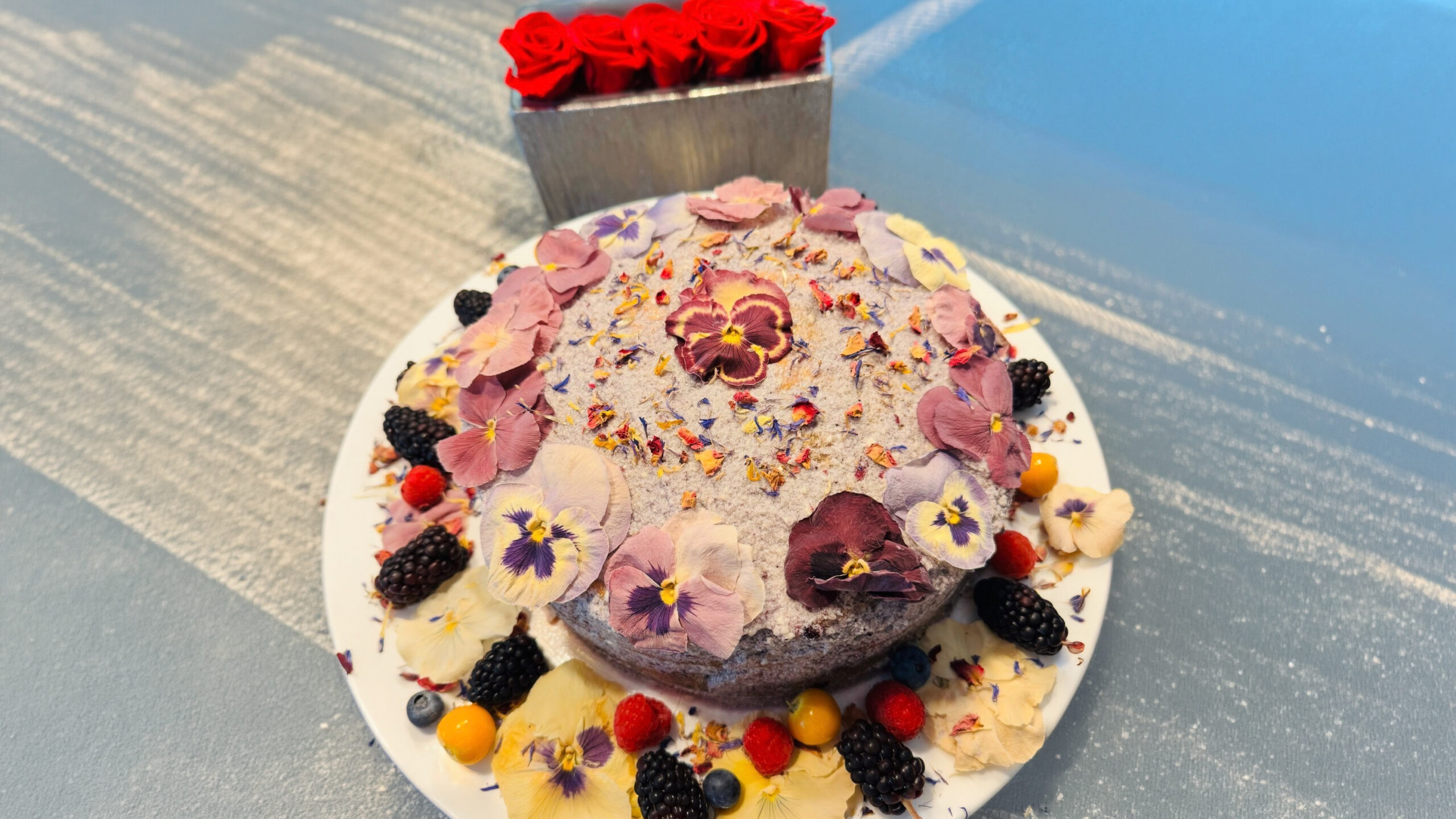
Make an elegant gluten-free lemon chiffon cake with Meyer lemon curd and silky blueberry-coriander Swiss meringue buttercream.
Light, airy, and bursting with fresh citrus flavor, this Elegant Gluten-Free Lemon Chiffon Cake Recipe with Blueberry Buttercream is a beautiful centerpiece for spring and summer celebrations. Tender lemon chiffon cake layers are filled with silky Meyer lemon curd and covered with blueberry-coriander Swiss meringue buttercream.
The chiffon cake gets its delicate texture from whipped egg whites folded gently into a lemon-infused batter. A combination of white rice flour, potato starch, and tapioca starch creates a soft gluten-free crumb without making the cake heavy. Fresh lemon zest and juice give every layer a bright flavor that beautifully complements the creamy filling.
Homemade blueberry-coriander jam transforms classic Swiss meringue buttercream into a colorful frosting with a sophisticated balance of flavors. Sweet blueberries soften the tart lemon notes, while toasted coriander contributes subtle warmth and a delicate citrus-like aroma.
Fresh blueberries, sliced kumquats, Meyer lemon wedges, mint, and edible flowers make this elegant gluten-free layer cake perfect for birthdays, bridal showers, Easter gatherings, Mother’s Day brunches, garden parties, and summer dinner parties. The blueberry jam and lemon curd can be prepared in advance, making the final assembly easier on the day of your celebration.
Directions
Step 1: Toast the Coriander
Place the coriander seeds in a small saucepan over medium heat. Toast until fragrant and lightly golden, stirring frequently to prevent burning.
Remove the seeds from the pan and allow them to cool. Grind them into a fine powder using a spice grinder or mortar and pestle. If using ground coriander, skip the toasting and grinding process.
Step 2: Prepare the Blueberry-Coriander Jam
Add the blueberries, granulated sugar, lemon zest, lemon juice, and coriander to the saucepan. Cook over medium-high heat, stirring occasionally, until the berries break down and the mixture thickens into a glossy jam, about 10 to 12 minutes.
Season lightly with kosher salt and remove the jam from the heat.
Strain enough jam through a fine-mesh sieve to obtain 3/4 cup of smooth, seedless jam for the buttercream. Press the berries firmly against the sieve to extract as much jam as possible. Reserve the remaining jam for decorating the cake.
Allow both portions to cool completely before using.
Step 3: Combine the Lemon Curd Ingredients
Place the granulated sugar, Meyer lemon zest, Meyer lemon juice, eggs, egg yolks, and kosher salt in a heatproof bowl. Whisk until smooth and thoroughly combined.
Set the bowl over a saucepan containing gently simmering water. Make sure the bottom of the bowl does not touch the water.
Step 4: Cook the Meyer Lemon Curd
Cook the lemon mixture over the simmering water, whisking constantly, until it thickens enough to coat the back of a spoon.
Remove the bowl from the heat. Whisk in the cold butter a few pieces at a time, allowing each addition to become fully incorporated before adding more.
Strain the curd through a fine-mesh sieve into a clean bowl. Press plastic wrap directly against the surface to prevent a skin from forming. Refrigerate until thoroughly chilled.
If preferred, substitute 1 1/2 cups prepared lemon curd and skip the homemade lemon curd steps.
Step 5: Prepare the Oven and Cake Pans
Preheat the oven to 350°F. Lightly coat two 8-inch round cake pans with baking spray and line the bottoms with parchment paper.
Step 6: Whip the Egg Whites
Place the egg whites and cream of tartar in the clean, dry bowl of a stand mixer fitted with the whisk attachment. Beat until the egg whites hold stiff peaks.
Transfer the whipped egg whites to a separate clean bowl and set them aside.
Step 7: Prepare the Egg Yolk Mixture
Place the egg yolks and granulated sugar in the stand mixer bowl. Beat for 5 to 8 minutes, or until the mixture becomes very pale, thick, and fluffy.
Slowly add the water, neutral oil, vanilla extract, lemon zest, and lemon juice. Mix until evenly incorporated.
Step 8: Combine the Dry Ingredients
In a separate bowl, whisk together the white rice flour, potato starch, tapioca starch, baking powder, salt, and xanthan gum.
Gradually fold the dry ingredients into the egg yolk mixture. Mix gently just until no dry streaks remain.
Step 9: Fold in the Egg Whites
Fold the whipped egg whites into the batter in several additions. Use gentle strokes to preserve as much air as possible and maintain the light chiffon texture.
Divide the batter evenly between the prepared cake pans and smooth the tops.
Step 10: Bake the Cake Layers
Bake the cakes for 18 to 22 minutes, or until the tops are lightly golden and spring back when gently touched.
Allow the cakes to cool in the pans for 10 minutes. Carefully turn them out onto wire racks, remove the parchment paper, and let them cool completely before assembling the cake.
Step 11: Heat the Buttercream Meringue
Combine the egg whites and granulated sugar in a clean heatproof bowl.
Set the bowl over a saucepan containing gently simmering water, making sure the bottom does not touch the water.
Whisk continuously until the sugar has dissolved and the mixture reaches 160°F.
Step 12: Whip the Meringue
Transfer the egg white mixture to the bowl of a stand mixer fitted with the whisk attachment. Beat on high speed until glossy, stiff peaks form and the bowl feels cool to the touch.
The meringue must be completely cool before adding the butter.
Step 13: Finish the Blueberry-Coriander Buttercream
With the mixer running on medium speed, add the softened butter 1 tablespoon at a time. Allow each addition to become incorporated before adding the next.
Continue beating until the buttercream becomes smooth, light, and silky.
Add 3/4 cup strained blueberry-coriander jam and the kosher salt. Beat until the jam is fully incorporated and the buttercream is evenly colored.
Step 14: Fill the Cake
Place one cooled cake layer on a serving plate or cake stand. Spread approximately 1 1/2 cups of buttercream over the surface, creating a raised border around the outside edge.
Spoon the chilled Meyer lemon curd into the center of the buttercream border and spread it into an even layer. Carefully place the second cake layer on top.
Step 15: Apply the Crumb Coat
Spread a thin layer of buttercream over the top and sides of the cake to trap loose crumbs. Refrigerate the cake for 15 minutes, or until the crumb coat feels firm.
Step 16: Decorate the Cake
Cover the chilled cake with the remaining blueberry-coriander buttercream. Smooth the top and sides or use a spatula to create decorative swirls.
Spoon small amounts of the reserved blueberry-coriander jam over the top. Decorate with fresh blueberries, sliced kumquats, Meyer lemon wedges, mint leaves, and edible flowers.
Step 17: Chill and Serve
Refrigerate the assembled cake for at least 30 minutes before slicing.
For the softest texture and fullest flavor, allow the cake to stand at room temperature for 20 to 30 minutes before serving.
Notes
The blueberry-coriander jam and Meyer lemon curd can be prepared up to two days before assembling the cake. Keep them covered and refrigerated until needed.
Meyer lemons provide a sweeter, more floral citrus flavor. Regular lemons can be used when Meyer lemons are unavailable.
Bring the eggs and other specified ingredients to room temperature before mixing. Room-temperature ingredients combine more evenly and support the light texture associated with chiffon cake.
Fold the whipped egg whites into the batter gently. Vigorous stirring can deflate the egg whites and produce denser cake layers.
Make sure the meringue has cooled completely before adding the softened butter. Warm meringue can melt the butter and prevent the frosting from becoming light and stable.
Swiss meringue buttercream may appear thin, separated, or curdled during mixing. Continue beating until it becomes smooth and creamy.
If the buttercream feels too warm or loose, refrigerate it briefly and then beat it again. If it feels too cold or stiff, allow it to warm slightly before continuing to mix.
If using frozen blueberries, there is no need to thaw them before cooking the jam.
Use edible flowers that have been specifically grown and labeled for culinary use. Avoid flowers treated with pesticides or other chemicals not intended for food.
Store the finished cake in a covered container in the refrigerator for up to four days. Let the cake or individual slices stand briefly at room temperature before serving for the best texture.
This recipe is gluten-free when prepared with appropriately labeled ingredients. Check the baking spray, baking powder, rice flour, starches, vanilla extract, prepared lemon curd, and other packaged ingredients for suitable gluten-free labeling. Prevent cross-contact during preparation when serving someone with celiac disease or gluten sensitivity.